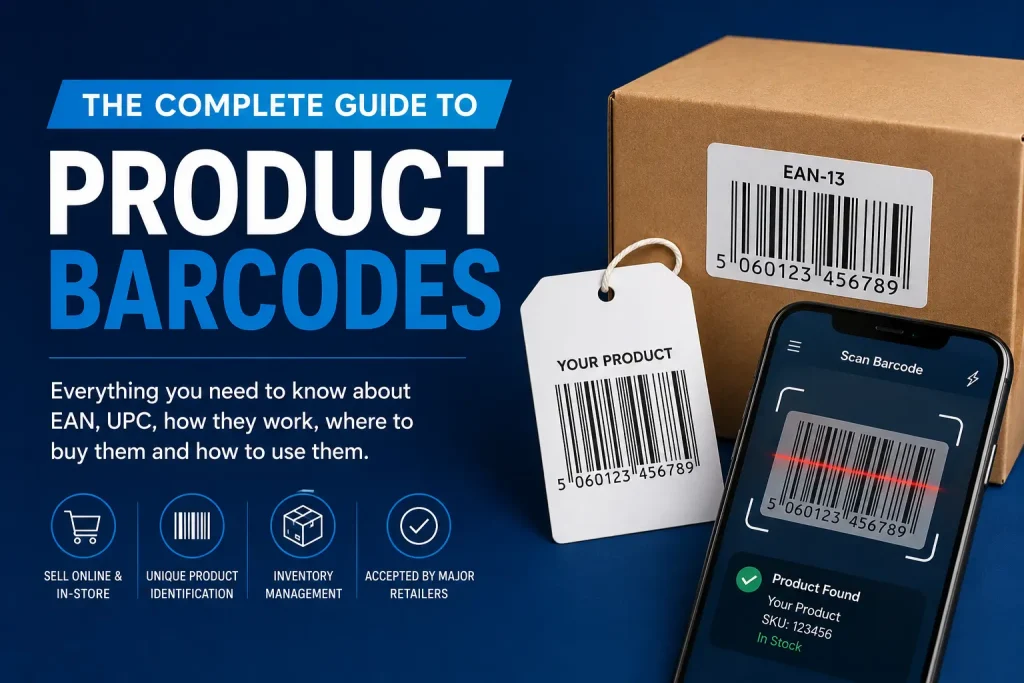
If you’re launching a new product, selling online, or expanding into retail, understanding product barcodes is essential. Whether you sell on Amazon, eBay, Shopify, Etsy, TikTok Shop or through traditional retailers, the correct barcode helps identify your products quickly and accurately.
This complete guide explains everything you need to know about product barcodes, including how they work, which barcode you need, where to buy them, and how to avoid common mistakes.
By the end of this guide, you’ll know exactly how to choose the right barcode for your business.
What Is a Product Barcode?
A product barcode is a unique machine-readable code that identifies a product. When scanned, it tells a retailer, warehouse or online marketplace exactly which product it is.
A barcode itself does not contain your product description, price or stock information. Instead, it contains a unique identification number that links to information stored within a retailer’s or business’s database.
For most UK businesses, this means using an EAN-13 barcode, while products sold primarily in North America often use UPC barcodes.
Why Are Product Barcodes Important?
Barcodes make selling products far easier.
They allow businesses to:
- Sell on online marketplaces
- List products on retailer websites
- Speed up warehouse operations
- Reduce manual data entry
- Improve inventory management
- Reduce human error
- Speed up checkout scanning
- Identify every product variation
Without a unique barcode, many online marketplaces and retailers simply won’t allow you to list your products.
What Information Does a Barcode Contain?
One of the biggest misconceptions is that a barcode stores lots of information.
It doesn’t.
A barcode simply represents a unique identification number.
When a scanner reads the barcode, the software looks up that number within its database and displays information such as:
- Product name
- SKU
- Price
- Colour
- Size
- Stock level
- Supplier
Think of it like a key that unlocks your product information.
EAN vs UPC Barcodes
The two most common retail barcode formats are:
EAN-13
The standard barcode used throughout:
- United Kingdom
- Europe
- Australia
- Much of the rest of the world
EAN barcodes contain 13 digits and are accepted by virtually every major retailer and online marketplace.
UPC-A
UPC barcodes contain 12 digits and are mainly used in:
- United States
- Canada
Many businesses purchase EAN barcodes that also include a matching UPC number, allowing products to be sold internationally.
Do You Need a Barcode?
You generally need a barcode if you intend to sell products on:
- Amazon
- eBay
- Shopify
- WooCommerce
- Etsy
- TikTok Shop
- Wix
- Squarespace
- BigCommerce
- Not On The High Street
Many physical retailers also require every product variation to have its own unique barcode.
If you’re only making products for personal use or internal stock control, you may not need retail barcodes.
For a more detailed explanation, read our guide:
Do I Need a Barcode to Sell My Product?
Which Products Need Their Own Barcode?
Every unique product needs its own barcode.
For example:
- Red T-Shirt (Small)
- Red T-Shirt (Medium)
- Red T-Shirt (Large)
- Blue T-Shirt (Small)
Although they are similar products, each variation requires its own barcode.
Likewise, different pack sizes need different barcode numbers.
A single mug and a pack of four mugs should never share the same barcode.
Where Can You Use Product Barcodes?
Product barcodes are accepted across thousands of selling platforms.
Including:
Amazon
Amazon uses product identifiers when creating listings.
eBay
Many eBay categories now require product identifiers.
Shopify
Shopify includes barcode fields for every product.
WooCommerce
WooCommerce supports barcode inventory systems through plugins and integrations.
TikTok Shop
TikTok Shop increasingly relies on product identifiers for catalogue management.
Etsy
Many Etsy sellers use barcodes when expanding into wholesale or multichannel selling.
What Is the Difference Between Retail and Internal Barcodes?
Businesses often confuse retail barcodes with internal inventory labels.
Retail barcodes:
- Identify products globally
- Are suitable for marketplaces
- Can be scanned by retailers
Internal barcodes:
- Work only inside your own business
- Often use Code 128 or Code 39
- Cannot normally be used to sell products through retailers
Understanding this difference helps avoid expensive mistakes.
How to Buy Product Barcodes
Buying barcodes is simple.
Step 1
Count how many unique products you have.
Remember that every variation requires its own barcode.
Step 2
Purchase the correct number of barcode numbers.
Step 3
Receive your barcode numbers instantly.
Step 4
Generate barcode images.
Step 5
Add them to your packaging or labels.
Step 6
Upload the barcode numbers when creating product listings.
Can I Reuse a Barcode?
No.
Each barcode should permanently identify one product.
Never reuse a barcode for another product once it has been assigned.
Doing so can create inventory problems and retailer confusion.
Barcode Printing Tips
Even the correct barcode can fail if printed badly.
Follow these best practices:
- Print in black on a white background
- Leave adequate quiet zones around the barcode
- Avoid stretching the barcode
- Print at a high resolution
- Test before large production runs
- Keep barcodes flat where possible
Poor print quality is one of the most common causes of scanning failures.
Common Barcode Mistakes
Many new sellers make avoidable errors.
These include:
- Using the same barcode twice
- Buying too few barcodes
- Printing barcodes too small
- Stretching barcode images
- Cropping quiet zones
- Mixing EAN and UPC incorrectly
- Using internal inventory codes as retail barcodes
Avoiding these mistakes saves time and prevents listing issues later.
Frequently Asked Questions
Can two products have the same barcode?
No.
Each unique product should have its own barcode.
Can I create my own barcode?
You can generate barcode images yourself once you have a unique barcode number.
However, simply creating random barcode numbers is not suitable for retail products.
Do handmade products need barcodes?
Not always.
However, if you intend to sell handmade products through marketplaces or retailers, barcodes are often required.
Do digital products need barcodes?
No.
Digital downloads generally do not require product barcodes.
Can I sell on Amazon without a barcode?
Some products may qualify for exemptions, but many listings require a product identifier.
Why Choose Get A Barcode?
At Get A Barcode, we make buying product barcodes simple.
When you purchase from us you’ll benefit from:
- Instant barcode delivery
- UK-based company
- No annual renewal fees
- Barcodes suitable for major online marketplaces
- Friendly customer support
- Easy ordering process
Whether you need one barcode or hundreds, we can help you get started quickly.
Related Guides
To learn more, explore these helpful resources on Get A Barcode:
- How to Buy a Barcode for a Product
- Do I Need a Barcode to Sell My Product?
- Barcode Myths Explained
- Barcode Checklist for New Businesses
- Common Barcode Mistakes New Sellers Make
- Barcode Requirements for Amazon
- Barcode Requirements for Shopify
- Barcode Requirements for Etsy
- Barcode Requirements for WooCommerce
- Barcode Requirements for eBay
- Barcode Requirements for Wix
- Barcode Requirements for Squarespace
- Barcode Requirements for BigCommerce
- Barcode Requirements for TikTok Shop
Final Thoughts
Product barcodes are an essential part of modern retail. They make inventory management easier, improve checkout efficiency, and help your products reach customers across online marketplaces and retail stores worldwide.
Choosing the correct barcode from the start saves time, prevents listing problems and supports future business growth.
If you’re ready to barcode your products, browse our range of barcode packages today and start selling with confidence.