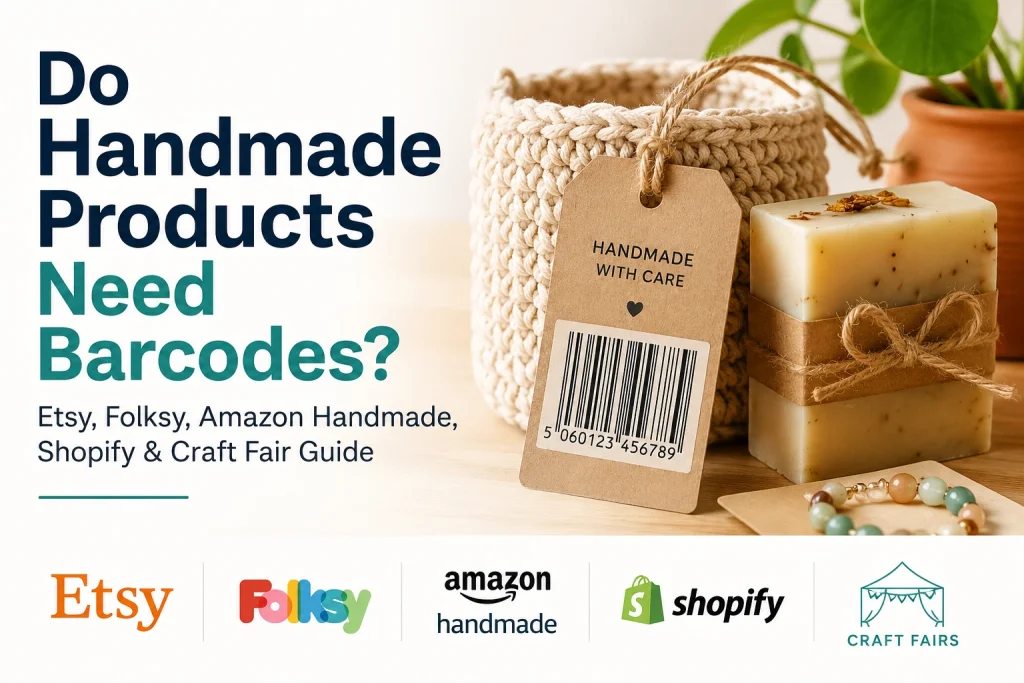
If you make and sell handmade products, you may be wondering whether you need a barcode. The answer depends on where you sell your products rather than the fact that they are handmade.
Many small businesses begin by selling at craft fairs or through online marketplaces before expanding into retail stores and larger eCommerce platforms. Understanding when you need a handmade product barcode can save you time, money and frustration as your business grows.
At Get A Barcode, we supply genuine retail barcode numbers that are suitable for thousands of businesses looking to sell products online and in shops. Whether you sell candles, soaps, jewellery, knitted goods, artwork, food products or handmade gifts, we can help you choose the right barcode for your products.
You can purchase your barcode numbers on our Buy Barcode Numbers page:
https://www.getabarcode.co.uk/product-category/buy-barcode-numbers
You can also learn more about our most popular product here:
What Is a Barcode for Handmade Products?
A barcode for handmade products is simply a unique product number that identifies one specific item. It allows retailers, warehouses and online marketplaces to recognise your products quickly and accurately.
Every different product should have its own barcode. If you sell:
- A blue candle
- A red candle
- A large candle
- A small candle
each variation should normally have its own barcode.
Using unique barcode numbers also makes inventory management much easier as your business expands.
When Do Handmade Products Need Barcodes?
Not every handmade seller needs barcodes immediately.
Generally speaking, you may not need barcodes if you only sell:
- Directly from your own website
- Through social media
- Face-to-face at local markets
- At small craft fairs where products are not scanned
However, you will often need product barcodes when selling through larger retailers, wholesalers or online marketplaces that require unique product identifiers. Requirements vary between platforms and selling methods.
Etsy Barcode Requirements
Many new sellers search for an Etsy barcode because they assume every listing requires one.
In reality, Etsy generally allows you to list handmade products without adding retail barcode numbers. Your listings are identified using Etsy’s own internal system rather than requiring an EAN or UPC.
However, there are good reasons to use barcodes anyway.
Adding a barcode to your packaging can:
- Prepare your products for future wholesale opportunities
- Make inventory easier to manage
- Help if you later sell through other marketplaces
- Give your products a more professional retail appearance
If you eventually expand beyond Etsy, already having barcode numbers assigned to each product saves considerable time.
Selling Handmade Products on Folksy
Like Etsy, Folksy focuses on genuine handmade products created by independent makers.
Most sellers can list products without retail barcodes because Folksy manages listings internally.
Nevertheless, assigning your own barcode numbers from the beginning provides several long-term benefits:
- Better stock management
- Easier product identification
- Simpler expansion into retail stores
- Professional packaging
Planning ahead means you won’t need to renumber products later.
Amazon Handmade Barcode Requirements
Amazon Handmade works differently from many other marketplaces.
Depending on the category, product type and listing method, some handmade sellers may qualify for a GTIN exemption, while others may still require product identifiers. Amazon’s requirements can vary and should always be checked before creating listings.
Many successful handmade businesses eventually move beyond Amazon Handmade into standard Amazon listings or wholesale distribution.
At that point, having retail barcode numbers already assigned to every product can make expansion much simpler.
If your long-term goal is to build a recognised brand, investing in barcode numbers early is often worthwhile.
Shopify and Handmade Products
If you sell through Shopify, the situation is different again.
Shopify itself does not generally require retail barcode numbers simply to create product listings.
However, barcodes become extremely useful for:
- Inventory management
- Barcode scanners
- Warehouse picking
- Order fulfilment
- Multi-channel selling
- Point of Sale (POS) systems
Many Shopify store owners assign barcodes from the very beginning so their products are ready for future growth.
Do You Need a Barcode for Craft Fairs?
A common question is whether you need a craft fair barcode.
Usually, the answer is no.
Most craft fairs allow vendors to sell products without retail barcodes because purchases are made directly with the seller.
That said, many handmade businesses still choose to barcode their products because it:
- Makes stock control easier
- Speeds up checkout with barcode scanners
- Looks more professional
- Helps when selling through multiple channels
If your craft business is growing, introducing barcodes early can save a lot of work later.
Benefits of Using Barcodes for Handmade Products
Even if your chosen selling platform doesn’t require them today, barcodes offer several advantages.
These include:
- Professional product packaging
- Faster stock management
- Easier expansion into retail
- Better warehouse organisation
- Simpler product identification
- Improved multi-channel selling
- One unique barcode for every product variation
Many successful handmade brands begin small but eventually supply retailers, gift shops and larger online marketplaces. Having a barcode system already in place makes that transition much smoother.
Choosing the Right Barcode
If you plan to sell internationally, an EAN barcode is recognised throughout the UK and Europe. Many sellers also use the same numbers for worldwide online selling.
At Get A Barcode, our barcode numbers are supplied instantly, have no annual renewal fees, and can be used across a wide range of retail and online selling platforms.
Browse our barcode packages here:
https://www.getabarcode.co.uk/product-category/buy-barcode-numbers
Or learn more about our most popular barcode package:
You may also find these guides helpful:
- https://www.getabarcode.co.uk/how-to-buy-a-barcode-for-a-product/
- https://www.getabarcode.co.uk/do-i-need-a-barcode-to-sell-my-product/
Frequently Asked Questions
Can I sell handmade products without barcodes?
Yes. Many handmade sellers begin without barcodes, particularly when selling directly to customers or through marketplaces that manage listings internally.
Does Etsy require a barcode?
Generally, Etsy does not require retail barcode numbers for handmade products, although using them can help prepare your business for future expansion.
Do I need a barcode for a craft fair?
Usually not. However, many growing businesses still use barcodes for stock control and professional presentation.
Does Shopify require barcodes?
Not for basic product listings. However, barcodes become extremely useful for inventory management, scanning and multi-channel selling.
Should every handmade product have its own barcode?
Yes. Every unique product or variation should normally have its own unique barcode number to avoid confusion and maintain accurate inventory.
Start Selling Handmade Products with Confidence
Whether you’re selling at local markets, through Etsy, on Folksy, with Shopify or planning to grow into Amazon and retail stores, having the right barcode strategy makes your business easier to manage.
Get A Barcode supplies affordable retail barcode numbers with instant delivery, helping handmade businesses prepare for future growth without ongoing annual fees.
Browse our barcode packages today and find the right solution for your handmade business.